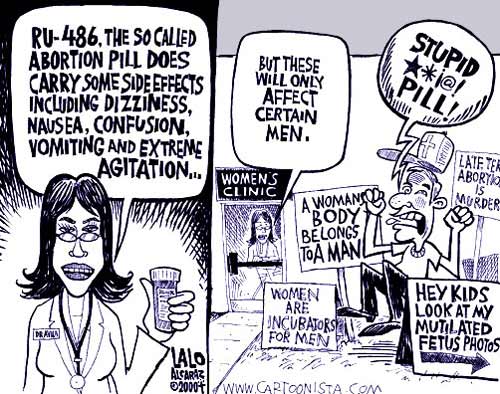
Anti RU486 group loses god

January 18th, 2006

A few days ago I heard about an organisation that has been set up to mobilise churches and anti-abortion groups against RU486.

“Australian Against RU486 is a coalition of concerned groups and individuals including pro-choice people campaigning on medical, ethical or moral grounds to keep ban on RU486. The coalition includes eminent doctors, physicians, academics, and community leaders from all over Australia. AA RU486 supports positive outcomes for Australian Women and believes that advocates of RU486 are endangering the lives of Australian women in the name of choice. AA RU486 is a trust established specifically and solely to campaign to keep the ban on RU486.” – Australians Against RU486 (aaRU486)

Simone Holzapfel, a former media adviser to Tony Abbott (before he became the Health Minister) heads the organisation.

Upon reading the group’s website, I see quotes that use guilt and fear to make the assertion that RU486 does not “offer a positive view of women.” Some quotes assume US law will one day become Australian law and whilst current trends would support that claim, it has not happened yet.

“RU486 causes severe malformations to babies that survive including fused limbs, brain malformations, kidney problems and genital malformations.”

“Many states have laws which require that the physician examine the fetal remains whatever is passed. Now the question is how is a young girl of 17 going to go plowing through a toilet bowl full of blood clots and other nasty things to try to find this tiny little fetus and bring it to the doctor?” Dr. Bernhard Nathanson

Curiously, whilst many church groups are involved in, and supportive of, RU486 their web presence places no reference to religious opposition to abortion.

Impressively, RU486 has done it’s research and concluded that Australia is far too secular to be a society for god to hold sway.

empty pews

Image from here

City/rural parity

January 9th, 2006

Currently there are four individual doctors and two separate applications with the Therapeutic Goods Administration (TGA) to become an authorised prescriber of the drug RU 486.

Professor Caroline de Costa an Obstetrician based in Cairns, was the first doctor to use the authorised prescriber route, which is available for medical practitioners in Australia if they want to use a drug for a particular patient or a group of patients which isn’t normally available in Australia.  Late last year Professor de Costa had her application (to prescribe RU 486) endorsed by the ethics committee of her hospital and now awaits a decision from the Health Minister.

The other three doctors are based in and around Mildura, Victoria. They argue that rural (and remote) women are disadvantaged by their geographical isolation when it comes to accessing an abortion.  The disadvantage is two-fold:

  1. Lack of local surgical resources
  2. Difficulty in controlling privacy 

A conscience vote is expected next month amoungst MP’s when parliament returns.

With paternalistic, infantilising rhetoric such as this, MP’s will hopefully show Australian women (and the men who support them) their sophistication and vote for the end of the current veto, the resumption of the TGA’s role and the widening of choice.

compliance 
Image from here  

Risk assessment choice.

January 3rd, 2006

A study conducted in New Zealand and published in the Journal of Child Psychology and Psychiatry and Allied Disciplines has findings suggesting that abortion in young women may be associated with increased risks of mental health problems.

Does this mean that young women should not have access to abortions – no, these findings should inform choice and clinical practice not dictate it.

"No-one’s denying the fact that there will be psychological problems in some women after this procedure (abortion) in the same way as there are after a hysterectomy. But we also know that having an unwanted pregnancy to term or having to give a child up for adoption because you can’t manage also is related to mental health problems."

"There’s lots of complex reasons why people might feel distressed and disturbed after abortions.  Most of the research shows that transient and short-lived feelings of anxiety or depression are probably quite common." – Director NSW Institute of Psychiatry, Dr. Louise Newman.

Consider mental health incidence figures for continuing with a pregnancy.

"The incidence of depression in women postpartum is similar to depression in women generally. However, the incidence of depression in the first month after childbirth is three times the average monthly incidence in non-childbearing women. Studies across different cultures have shown consistent incidence of postnatal depression (10 to 15 percent), with higher rates in teenage mothers. A meta-analysis of studies, mainly based in developed countries, found the incidence of postnatal depression to be 12 to 13 percent.

Four systematic reviews have identified the following risk factors for postnatal depression:

  1. Past history of psychopathology, including postnatal depression;
  2. Low social support;
  3. Poor marital relationships;
  4. Recent life events.

Recent studies from India and China also suggest that spousal disappointment with the sex of the newborn child, particularly if the child is a girl, is associated with postnatal depression. The mother’s reaction to the sex of the baby also may be a risk factor within some cultural groups."

Just as a woman can choose pregnancy to birth (advised of known risks) so a woman can choose pregnancy to end (advised of known risks).

Update: A succinct piece by Julia Baird.

creating a balanced choice

Image from here

Money, Morphine and the good Doctors.

December 28th, 2005

Mr. Packer is dead.

Money seems to be able to buy you anything you want, even death at the time of your choosing.

I was working in an allied health role in the Northern Territory for the nine months that Australians had a Rights Of the Terminally Ill Act (ROTI), commonly called “The Euthanasia Bill”. The ROTI Act was overturned by the federal government in March 1997. Effectively the right to test if you qualified for the strict criteria to access ROTI and potentially die at the time of your choosing (as opposed to suicide), was taken away from an individual and their medical carers- and returned to god and palliative care.

But not if you are rich. If you are rich, I am sure it is possible to have your carefully chosen doctors organise morphine and have your death with your family around you in your home.

“This is my time.” – said Mr. Packer.

In this country, money can buy you a way around god and Justice Minister Senator Ellison deciding your quality of life.

It can buy you a good death.

We all deserve that.

Morpheus and Isis

Morpheus and Iris, 1811. Guerin, Pierre Narcisse from here

Moore TGA, less Health Minister

December 15th, 2005

I was pleased to hear the focused clarity of Claire Moore’s speech to the senate committee this morning in ABC radio’s AM program.  Senator Moore is the Deputy Chairwoman of the Senate committee on the question of whether the Health Minister should be allowed to veto RU486 or if its approval/non-approval should be left to the Therapeutic Goods Administration (TGA).

Senator Moore has warned her colleagues not to turn today’s Senate hearing into a wider inquiry into abortion itself.

In describing what she saw as the committee’s agenda, senator Moore said,

"Well, I’ll listen with an open mind, but I think I would be unlikely to be swayed by any evidence that could possibly say why ministerial discretion should be used in health issues. I have made no secret of the fact that I think that in this process we should be looking at a single referral for all medications."

Thank you Senator Moore!
Unlike your colleagues – One who is woefully ignorant of the law and the other who espouses pro-women policy, yet would be anti-woman 90% of the time.

far too many fanatical men  

Image from here